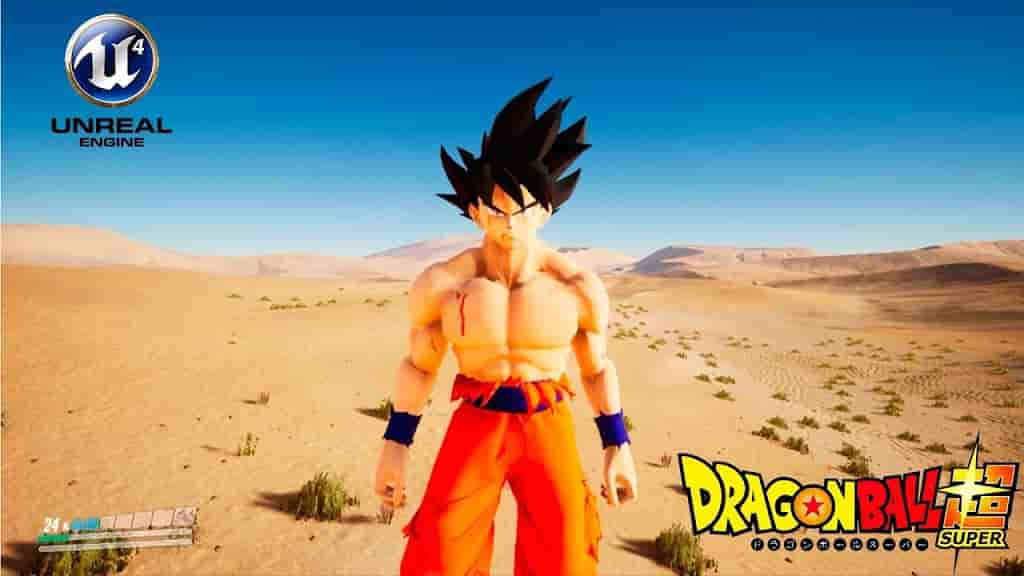
Official Dragon Ball games are plentiful, but they rarely deliver the exact fantasy fans actually want: massive, destructible arenas, beam struggles that feel like beam struggles, and character rosters built by people who grew up obsessing over the source material rather than a licensing checklist. Dragon Ball Unreal is a fan project that set out to close that gap — and its development story is as interesting as the game itself.
Dev Background
Dragon Ball Unreal comes from Emudshit, a YouTuber and self-described die-hard Dragon Ball fan who first announced the project on July 13, 2015. What makes the project notable isn't just its ambition — it's that Emudshit has largely built it solo, with friends occasionally pitching in on character modeling. That's a small team by any standard for a project this visually demanding, and by the time this was documented, it represented roughly three years of sustained solo development.
Emudshit funds and sustains the work through a YouTube channel with over 100,000 subscribers and a Patreon page, the two main levers indie and fan developers lean on when there's no publisher writing the checks.
Engine and Platforms
The game runs on Unreal Engine 4, chosen specifically for the fidelity it allows in effects work — beam clashes, aura lighting, and large open arenas are all easier to sell convincingly on UE4 than on a lighter-weight engine. The initial release target is PC, with PS4 and Xbox One floated as possible future ports if development allows. Nothing beyond PC has been committed to.
Gameplay and Mechanics
The core hook is combat that actually captures Dragon Ball's signature spectacle rather than approximating it:
- Kamehameha beam spam and clashes — players can fire and multiply Kamehameha waves by holding the button down, and the collision effect when two beams meet is one of the project's standout visual moments.
- Flight with turbo boost — full aerial movement rather than ground-locked fighting, matching how the anime actually stages its fights.
- Ki blasts and signature techniques — character-specific special moves rather than a single shared moveset reskinned across the roster.
- Charge-up aura and lightning effects — the kind of detail work (crackling energy, environmental distortion) that low-budget licensed games routinely skip.
- Large, open maps — built at a scale meant to support Dragon Ball's over-the-top fight choreography instead of cramped arena boxes.
Confirmed Characters
The roster confirmed at the time of documentation covers several of the franchise's most iconic forms:
- Goku — Super Saiyan, Super Saiyan 3, Super Saiyan 4, Super Saiyan God, Super Saiyan Blue, and Ultra Instinct
- Vegeta — Super Saiyan, Super Saiyan 4, Super Saiyan Blue
- Beerus
- Broly
- Goku Black
- Gogeta SSJ4
- Hit
- Golden Oozaru
That's a roster spanning multiple Dragon Ball eras — original Z-era transformations through Super's godly forms — which explains part of why a one-person team needed years to get through it.
System Requirements
As a fan project running on Unreal Engine 4, Dragon Ball Unreal doesn't demand a high-end rig, but it's not trivial either given the effects-heavy combat.
Minimum:
- CPU: Intel Core2Quad Q9400
- GPU: Nvidia GTX 750 or AMD Radeon R7 260X
- RAM: 4GB
Recommended:
- CPU: Intel i3 2120 or i5 2400
- GPU: AMD Radeon R9 270X
- RAM: 4GB
Worth noting: the recommended tier only bumps the CPU and GPU — RAM stays at 4GB either way, which tracks for a project scoped and optimized by a solo developer rather than a studio with QA headcount to stress-test scaling.
Where Things Stood
Dragon Ball Unreal is a good example of what a fan project can accomplish when it's driven by someone who genuinely understands what makes the source material work visually. Whether it ever reaches a broad public release depends entirely on one person's continued time and funding — there's no publisher deadline forcing it out the door, for better and worse. If you're tracking it, Emudshit's YouTube channel and Patreon remain the places to watch for updates.
Written by Saad Nadeem
Founder & Writer · TwiceGaming
Founder of TwiceGaming. Writes hardware reviews, game guides, and how-tos with a focus on honest, practical advice — no sponsored fluff, no filler.